


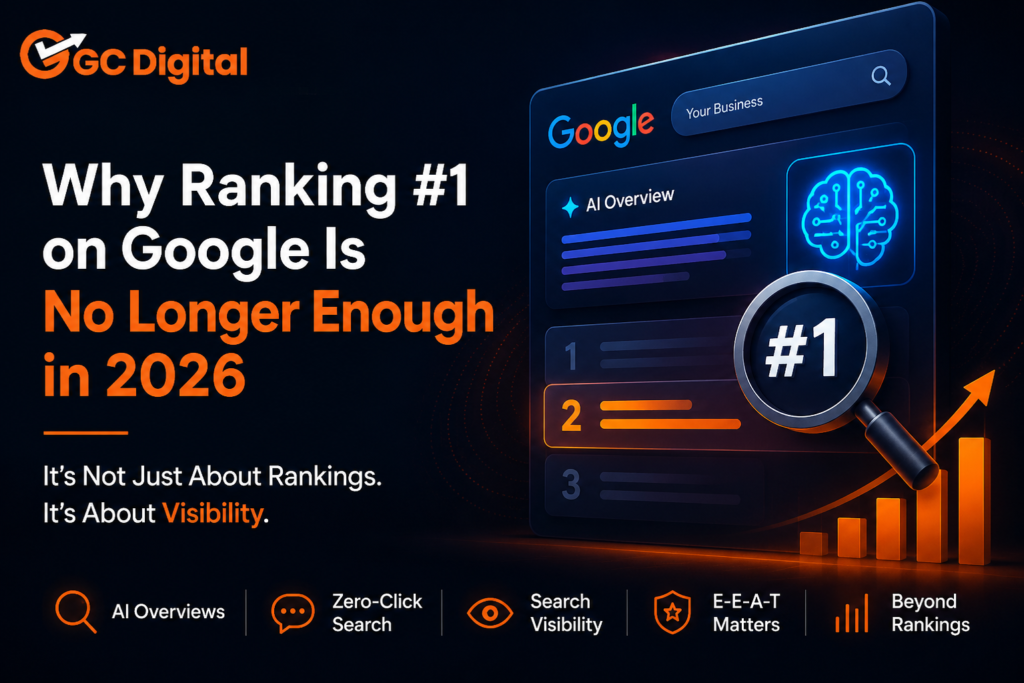
For over two decades, the goal of SEO was simple: get to position one. Marketers built entire strategies, budgets, and KPIs around that single blue link at the top of the page. But if you’re still measuring success purely by Google search ranking in 2026, you’re optimizing for a search engine that no longer exists in the way it used to.
Google has quietly rewired how people find, read, and act on information. AI Overviews, zero-click answers, and generative search experiences now sit above the traditional results, often answering the query before a user ever scrolls down to the “#1” result. Ranking #1 still matters, but it’s no longer the finish line. It’s just one signal in a much bigger picture of search visibility.
The numbers back this up. Industry research shows that when an AI Overview appears on a query, click-through rate for the top-ranking organic page drops by as much as 58%, and one widely cited zero-click study found that well over half of all Google searches now end without a click to any website at all. Ranking #1 on Google search results used to be the reward. In 2026, it’s often just the starting point.
Here’s why brands need to rethink what winning in Google SEO actually looks like this year.
The classic ten blue links are a shrinking part of the page. Google search results in 2026 are a patchwork of AI-generated summaries, featured snippets, video carousels, shopping modules, local packs, and “People Also Ask” boxes, often appearing before any organic listing shows up at all.
This means:
Ahrefs’ own analysis of ranking data found that the top-ranking page captures the most total search traffic for a keyword only about half the time. Position and traffic have quietly become two different scoreboards. The practical effect is that organic search ranking and organic visibility have started to diverge. You can rank #1 and still see traffic decline, because the page real estate above you has grown.
Old-school SEO treated ranking factors like a checklist: keyword in the title, backlinks, page speed, done. The Google ranking factors 2026 landscape works differently: it evaluates content as part of a broader system of trust, relevance, and usefulness, commonly discussed under the Experience, Expertise, Authoritativeness, and Trustworthiness (E-E-A-T) framework.
Some of the shifts worth building strategy around:
In short: search engine ranking today is less about gaming a formula and more about proving depth, credibility, and usefulness across an entire domain.
The biggest mindset shift in SEO trends 2026 is the rise of what the industry is now calling Generative Engine Optimization (GEO) and Answer Engine Optimization (AEO), sitting alongside traditional SEO rather than replacing it. Visibility now happens in more places than the search results page itself.
This means measuring success purely through rank-tracking tools misses a growing share of how customers actually encounter your brand. A page can be quoted inside an AI Overview, referenced in a chatbot answer, or shown in a video snippet, all without a traditional #1 ranking. Getting cited is becoming just as valuable as getting clicked.
If ranking #1 isn’t the whole game anymore, what should teams focus on instead?
Build for the whole SERP, not just the blue link. Optimize content structure (clear headings, direct answers, FAQ schema) so it’s eligible to appear in AI Overviews, featured snippets, and other rich results, not just the standard organic listing.
Prioritize topical depth over isolated pages. A cluster of genuinely useful, interlinked content on a subject builds more durable organic visibility than a single page chasing one high-volume keyword.
Invest in real expertise and original data. Content that reflects genuine experience, such as original research, first-hand examples, and expert commentary, is harder for competitors (and AI-generated content) to replicate, and it’s exactly what Google’s systems are designed to reward.
Track visibility, not just position. Impressions, AI Overview appearances, brand mentions, and assisted conversions are becoming just as important as rank-tracking reports. If AI platforms are citing your content without sending traffic, that’s still a form of reach worth measuring.
Optimize for machines and humans at once. Clean structured data and clear, well-organized writing help both traditional crawlers and AI summarization systems understand and surface your content accurately.
Ranking #1 on Google search ranking reports still looks great in a slide deck. But in 2026, it’s a vanity metric if it isn’t backed by actual search visibility: the sum of every place your brand shows up across an increasingly AI-mediated search experience.
The brands that win this year won’t be the ones obsessing over a single position. They’ll be the ones building genuine authority, structuring content for AI and human readers alike, and measuring success across the full spectrum of how people now discover information, not just where they land on a page that fewer people are scrolling through in the first place.