


Ask ten business owners what they are doing for online marketing, and you will get ten different answers. One is running Instagram reels, another has just paid for Google Ads, a third says his cousin told him to “do SEO”. Most of them are busy, a little unsure, and quietly wondering whether the money is going anywhere.
The problem is rarely effort. It is direction. People pick a platform because it is popular and only later ask what they wanted from it. A proper digital marketing strategy flips that order. You begin with what your business needs, then decide where to show up and how much to spend.
This post walks you through that process in plain terms: how the main channels differ, what suits which kind of business, what it roughly costs to get started, and the mistakes worth avoiding.
Put simply, it is your answer to four questions. What do you want? Who do you want it from? Where will you reach them? How will you know it worked?
You will also hear people talk about a digital marketing plan for business, and the two are easy to confuse. The strategy is the thinking. The plan is the to-do list that comes out of it: which pages to write, which ads to run, who does what, and by when. A dentist might decide on a strategy of attracting patients from the neighbourhood through search. The plan then spells out the Google Business Profile updates, the service pages and the monthly review requests.
Any digital marketing strategy for business needs a number attached to it. “We want more visibility” does not tell you anything. “We want 25 genuine enquiries a month from our city” does, and you can check it every month.
Without one, marketing turns into a mood. You post when you have time, run ads when the month has gone well, and stop when it has not. Nothing builds up.
A clear online marketing strategy changes that in a few quiet ways. Your message gets sharper because you know who you are talking to. Your money goes where your customers actually are instead of being spread thin. And when a lead comes in, you can usually tell where it came from.
It also helps to accept early that there is no single best online marketing strategy. A clothing label, a CA firm and a software company sell to very different people in very different ways. Copying what worked for someone else’s business is one of the easiest ways to waste a year.
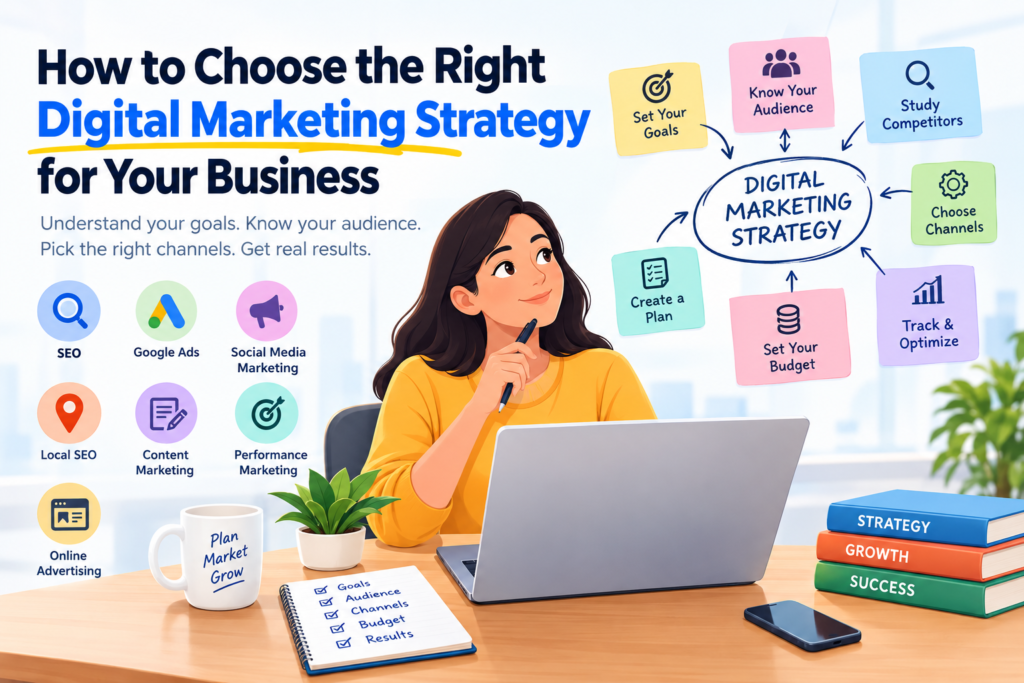
If you are stuck on how to choose a digital marketing strategy, work through these eight steps in order. They are simple, but most people skip at least two.
Be specific. More calls, more online orders, more walk-ins, or a first batch of customers for a new product?
Who buys from you, what are they trying to fix, and where do they look for answers? A retired professional searching on Google and a college student scrolling Instagram need very different handling.
Search for your own service the way a customer would. See who shows up, who is advertising and who is active on social media.
Check your website on a phone, look at your Google listing and read your reviews. Sometimes fixing what you already have is the best first move.
Match them to the goal. If people search for what you sell, search channels deserve attention. If the product is visual, social media may do more.
Be honest about it. Two channels done well beat five done halfway.
Decide in advance what counts as a win.
Your first version will not be perfect, and that is fine.
To make this concrete, picture three businesses. A neighbourhood bakery would do well to sort out its Google Business Profile, collect reviews and post good photos. A young startup selling a new app might test a small Google Ads budget to see whether anyone wants it, while slowly building helpful content. An established company with a bigger team might invest in long-term SEO and content while running targeted campaigns for specific products. Three different answers, and all of them can be right.
So the best digital marketing strategy is simply the one that fits your goals, audience and budget, and gets adjusted as you learn.
When people ask about digital marketing strategies for small business, they usually mean one of the options below. Each one has real strengths and real limits.
SEO is about making your website easy for search engines to understand and genuinely useful for people who land on it. A sensible SEO strategy for business covers keyword research, well-written page titles and headings, technical basics like speed and mobile layout, internal linking, and content that actually answers questions.
It is slow, and anyone who says otherwise is selling something. But it also keeps paying back long after the work is done. If you do not have the time or skills in-house, SEO services for small business can take care of the technical and research side so you can focus on running things.
Google Ads puts you in front of people at the exact moment they are searching for what you offer. Used well, Google Ads for business involves careful keyword choices, a clear goal for each campaign, a landing page that matches the ad, conversion tracking and regular budget checks.
The big plus is speed. The big minus is that when you stop paying, the traffic stops too, and a badly set up campaign can burn money quickly. That is why many owners hire a Google Ads agency for small business instead of learning it by trial and error.
A workable social media marketing strategy starts with choosing the one or two platforms where your customers really spend time, instead of being everywhere. After that it is about planning content ahead, replying to people, building a small community and, if it makes sense, running paid campaigns.
Social media is good for awareness and relationships, but the results depend entirely on the quality and consistency of what you post. If that is hard to keep up, social media marketing services can help plan and manage it so your page does not go silent for a month.
If your customers live or work nearby, a local SEO strategy can be the most valuable thing you do. It means keeping your Google Business Profile complete, your listings consistent, your reviews healthy, and having pages that speak to specific areas you serve.
Think about how people search for a clinic or a salon. They add a locality or “near me”, and they are usually ready to act. That is why local businesses tend to gain a lot from a location-focused approach.
A content marketing strategy is about being useful before asking for anything. Blog posts, service pages, short videos, case studies and FAQs all help someone decide, and they build trust while doing it. It asks for patience and consistency, but good content keeps working for you long after you publish it.
A performance marketing strategy is built around campaigns where every rupee can be traced. You decide what counts as a result, such as a form fill, a call or a purchase, track it properly, and keep an eye on lead generation and return on ad spend. It is wonderfully data-driven, but only if your tracking is accurate to begin with.
Online advertising for small business can mean search ads, social ads, display ads or remarketing to people who already visited your site. The trick is to pick the platforms your audience actually uses, test a few versions of your message, and judge results by leads and sales, not just clicks.
Marketing Channel | Best For | Main Advantage | Important Consideration |
SEO | Long-term organic visibility | Can attract relevant search traffic | Results often take time |
Google Ads | Businesses seeking targeted paid traffic | Campaigns can begin delivering traffic quickly | Requires budget and ongoing optimisation |
Social Media Marketing | Brand awareness and audience engagement | Builds relationships with relevant audiences | Results depend on content and audience fit |
Local SEO | Businesses serving specific locations | Improves local search visibility | Requires accurate business information and ongoing management |
Content Marketing | Education and trust building | Supports discovery and decision-making | Requires useful, consistent content |
Performance Marketing | Measurable acquisition campaigns | Supports data-driven optimisation | Needs accurate tracking and clear conversion goals |
These channels are not rivals. Content feeds SEO, SEO supports local visibility, and ads can bring quick traffic while the slower work catches up. Still, no single channel is right for every business.
Digital marketing for small business works best when it stays focused. Get the basics right first: a clean, mobile-friendly website, a complete Google Business Profile and some local SEO. Then add one paid or social channel once the foundation is solid.
Digital marketing for startups is mostly about learning fast. You may not yet know which message or audience works, so small paid tests are useful. Alongside, start building helpful content and a simple SEO base so you are not depending on ads forever.
Clinics, salons, coaching classes and repair services run on trust and proximity. Local SEO, genuine reviews, a strong Google profile and tightly targeted ads for nearby areas usually make the most sense.
Online stores need to be found and then need to make buying easy. SEO for product and category pages, tracked performance campaigns, and social media for discovery and remarketing are the usual building blocks.
B2B buyers take their time and compare carefully. Content, SEO, case studies and focused lead generation campaigns help you stay visible and credible through that longer decision.
In every case, the right mix depends on your budget, how your customers behave, who you compete with and what you want. Treat the above as starting points, not rules.
Once the direction is clear, you need to turn it into something people can actually do. A practical digital marketing plan for business usually answers these things:
If you are drawing up a digital marketing plan for startups, keep it lean. Fewer channels, shorter review cycles, and a willingness to change course when the numbers say so.
There is no magic figure, and be wary of anyone who quotes one without asking about your business. Your digital marketing budget for small business depends on how big you are, how crowded your industry is, what you want from the campaigns, whether you use an agency or a freelancer, how much creative work like design or video is involved, and how much you put into ads.
That last point trips people up. Service fees are what you pay a professional or agency to plan and manage the work. The advertising budget is what goes to Google or social platforms to actually run ads. They are two separate costs, and it helps to plan for both.
A sensible way to begin is with realistic goals and a small test. See what brings genuine enquiries, then put more behind what works. Nobody can promise results, so growing on evidence is safer than spending big on assumptions.
People searching for how to grow business online often hope for one big trick. In reality, it is a handful of small things done consistently.
Start with your website. If it loads slowly, looks poor on a phone or hides the contact button, even great marketing will leak customers. Then write content that answers the questions people actually ask you on calls. Keep your local listings accurate, because for many businesses that is where the nearest customers come from.
If you want faster movement, targeted Google Ads can help, as long as each ad leads to a landing page that matches what the person searched for. Alongside, build trust with real reviews and useful social posts, since people check before they buy.
When owners ask how to get more customers online, the honest answer is that visibility is only half of it. People also need to trust you and find it easy to reach you. The same goes for how to generate leads online: it is not just about traffic, it is about turning the right visitors into real enquiries with a clear offer and a simple form. Then follow up quickly, because a fast reply often decides who wins the customer. And always measure conversions, not just clicks.
If you decide you want help, take your time choosing. A good digital marketing agency should want to understand your business before suggesting anything. When comparing a digital marketing agency in Mumbai, a few things are worth checking.
Look at whether they have worked with businesses like yours. Ask what their reports look like and whether you will see real numbers on leads and costs. Check that the services they offer match your needs instead of a fixed package. Notice how quickly and clearly they communicate. Be careful with anyone who guarantees rankings or instant results. Ask how they track conversions. And pay attention to whether they ask about your goals first. The ones who do are usually the ones worth talking to.
You will see plenty of people searching for the best digital marketing agency in Mumbai, but “best” really means the one that fits your goals, budget and way of working. Rather than trusting labels, have a conversation, look at the actual work and judge for yourself.
The GC Digital provides digital marketing services for business, and you are welcome to look through what it offers and share your requirements to see whether it is a fit.
Track the numbers that connect to what you set out to achieve. Organic traffic and keyword visibility show how your SEO is moving. Qualified leads tell you whether the right people are reaching out. Conversion rate shows how many visitors take action. Customer acquisition cost and cost per lead show what it takes to win business, return on ad spend shows what your ads earn against what you spend, and sales are the final proof.
Which of these matter most depends on your goals. A new business may care about enquiries first, while an online store will watch sales and return on ad spend closely.
The right digital marketing strategy is not the fanciest one, or the one your competitor happens to be using. It is the one that fits your goals, your audience, your budget and your industry, and that you keep improving with real data.
You do not need to be on every platform or run every kind of campaign at once. Pick the channels that matter most for your business, watch what happens, and make small improvements every month. Steady steps usually beat scattered effort.
If you would like expert support, visit The GC Digital’s website to explore its digital marketing services, or reach out and talk through your business goals with the team.
There is no single best option. Many small businesses do well starting with local SEO, a solid website and a small, tracked ad campaign. Content and social media can come in as your time and budget grow.
Begin with your goals, then understand your audience and competitors. Review your current online presence, pick two or three suitable channels, set a realistic budget, define KPIs, and keep adjusting based on what the results show.
Neither wins every time. Google Ads can bring traffic quickly but needs ongoing spend, while SEO builds visibility slowly and lasts longer. Many small businesses use both, depending on budget, competition and how soon they need enquiries.
It depends on your industry, goals and whether you use an agency. Instead of chasing a fixed number, start with an amount you are comfortable testing, track results closely, and increase spend on what brings genuine leads.
Startups can begin with small, targeted Google Ads campaigns and a clear landing page, while building helpful content on the side. Add local or niche SEO and social media for awareness, and track every enquiry so you learn what works.
Yes, especially if you serve a specific area. It helps nearby customers find you on Google Search and Maps. A complete Google Business Profile, consistent listings and honest reviews can make a real difference.
It varies by channel. Paid ads can bring traffic within days, while SEO and content usually take a few months to build momentum. Results also depend on competition and consistency, so no one can promise exact timelines.
It can help if you lack the time or skills to manage campaigns well. Look for transparent reporting, relevant experience and honest expectations. If you can handle the basics yourself, you could start small and bring in support later.
Google Ads, SEO, local SEO and content marketing often work well because they reach people already searching. Paid social can also help. The right mix depends on your audience and what you offer.
Track metrics linked to your goals: qualified leads, conversion rate, cost per lead, return on ad spend, organic traffic and sales. Review them monthly and change your plan based on what the data shows.
Agar chahein toh main SEO title, meta description, slug aur image alt text bhi isi version ke hisaab se dobara de sakta hoon.
Conclusion faq ke nice do blog me
Yeh raha poora blog, ab Conclusion FAQs ke neeche hai.
Ask ten business owners what they are doing for online marketing, and you will get ten different answers. One is running Instagram reels, another has just paid for Google Ads, a third says his cousin told him to “do SEO”. Most of them are busy, a little unsure, and quietly wondering whether the money is going anywhere.
The problem is rarely effort. It is direction. People pick a platform because it is popular and only later ask what they wanted from it. A proper digital marketing strategy flips that order. You begin with what your business needs, then decide where to show up and how much to spend.
This post walks you through that process in plain terms: how the main channels differ, what suits which kind of business, what it roughly costs to get started, and the mistakes worth avoiding.
Put simply, it is your answer to four questions. What do you want? Who do you want it from? Where will you reach them? How will you know it worked?
You will also hear people talk about a digital marketing plan for business, and the two are easy to confuse. The strategy is the thinking. The plan is the to-do list that comes out of it: which pages to write, which ads to run, who does what, and by when. A dentist might decide on a strategy of attracting patients from the neighbourhood through search. The plan then spells out the Google Business Profile updates, the service pages and the monthly review requests.
Any digital marketing strategy for business needs a number attached to it. “We want more visibility” does not tell you anything. “We want 25 genuine enquiries a month from our city” does, and you can check it every month.
Without one, marketing turns into a mood. You post when you have time, run ads when the month has gone well, and stop when it has not. Nothing builds up.
A clear online marketing strategy changes that in a few quiet ways. Your message gets sharper because you know who you are talking to. Your money goes where your customers actually are instead of being spread thin. And when a lead comes in, you can usually tell where it came from.
It also helps to accept early that there is no single best online marketing strategy. A clothing label, a CA firm and a software company sell to very different people in very different ways. Copying what worked for someone else’s business is one of the easiest ways to waste a year.
If you are stuck on how to choose a digital marketing strategy, work through these eight steps in order. They are simple, but most people skip at least two.
Be specific. More calls, more online orders, more walk-ins, or a first batch of customers for a new product?
Who buys from you, what are they trying to fix, and where do they look for answers? A retired professional searching on Google and a college student scrolling Instagram need very different handling.
Search for your own service the way a customer would. See who shows up, who is advertising and who is active on social media.
Check your website on a phone, look at your Google listing and read your reviews. Sometimes fixing what you already have is the best first move.
Match them to the goal. If people search for what you sell, search channels deserve attention. If the product is visual, social media may do more.
Be honest about it. Two channels done well beat five done halfway.
Decide in advance what counts as a win.
Your first version will not be perfect, and that is fine.
To make this concrete, picture three businesses. A neighbourhood bakery would do well to sort out its Google Business Profile, collect reviews and post good photos. A young startup selling a new app might test a small Google Ads budget to see whether anyone wants it, while slowly building helpful content. An established company with a bigger team might invest in long-term SEO and content while running targeted campaigns for specific products. Three different answers, and all of them can be right.
So the best digital marketing strategy is simply the one that fits your goals, audience and budget, and gets adjusted as you learn.
When people ask about digital marketing strategies for small business, they usually mean one of the options below. Each one has real strengths and real limits.
SEO is about making your website easy for search engines to understand and genuinely useful for people who land on it. A sensible SEO strategy for business covers keyword research, well-written page titles and headings, technical basics like speed and mobile layout, internal linking, and content that actually answers questions.
It is slow, and anyone who says otherwise is selling something. But it also keeps paying back long after the work is done. If you do not have the time or skills in-house, SEO services for small business can take care of the technical and research side so you can focus on running things.
Google Ads puts you in front of people at the exact moment they are searching for what you offer. Used well, Google Ads for business involves careful keyword choices, a clear goal for each campaign, a landing page that matches the ad, conversion tracking and regular budget checks.
The big plus is speed. The big minus is that when you stop paying, the traffic stops too, and a badly set up campaign can burn money quickly. That is why many owners hire a Google Ads agency for small business instead of learning it by trial and error.
A workable social media marketing strategy starts with choosing the one or two platforms where your customers really spend time, instead of being everywhere. After that it is about planning content ahead, replying to people, building a small community and, if it makes sense, running paid campaigns.
Social media is good for awareness and relationships, but the results depend entirely on the quality and consistency of what you post. If that is hard to keep up, social media marketing services can help plan and manage it so your page does not go silent for a month.
If your customers live or work nearby, a local SEO strategy can be the most valuable thing you do. It means keeping your Google Business Profile complete, your listings consistent, your reviews healthy, and having pages that speak to specific areas you serve.
Think about how people search for a clinic or a salon. They add a locality or “near me”, and they are usually ready to act. That is why local businesses tend to gain a lot from a location-focused approach.
A content marketing strategy is about being useful before asking for anything. Blog posts, service pages, short videos, case studies and FAQs all help someone decide, and they build trust while doing it. It asks for patience and consistency, but good content keeps working for you long after you publish it.
A performance marketing strategy is built around campaigns where every rupee can be traced. You decide what counts as a result, such as a form fill, a call or a purchase, track it properly, and keep an eye on lead generation and return on ad spend. It is wonderfully data-driven, but only if your tracking is accurate to begin with.
Online advertising for small business can mean search ads, social ads, display ads or remarketing to people who already visited your site. The trick is to pick the platforms your audience actually uses, test a few versions of your message, and judge results by leads and sales, not just clicks.
Marketing Channel | Best For | Main Advantage | Important Consideration |
SEO | Long-term organic visibility | Can attract relevant search traffic | Results often take time |
Google Ads | Businesses seeking targeted paid traffic | Campaigns can begin delivering traffic quickly | Requires budget and ongoing optimisation |
Social Media Marketing | Brand awareness and audience engagement | Builds relationships with relevant audiences | Results depend on content and audience fit |
Local SEO | Businesses serving specific locations | Improves local search visibility | Requires accurate business information and ongoing management |
Content Marketing | Education and trust building | Supports discovery and decision-making | Requires useful, consistent content |
Performance Marketing | Measurable acquisition campaigns | Supports data-driven optimisation | Needs accurate tracking and clear conversion goals |
These channels are not rivals. Content feeds SEO, SEO supports local visibility, and ads can bring quick traffic while the slower work catches up. Still, no single channel is right for every business.
Digital marketing for small business works best when it stays focused. Get the basics right first: a clean, mobile-friendly website, a complete Google Business Profile and some local SEO. Then add one paid or social channel once the foundation is solid.
Digital marketing for startups is mostly about learning fast. You may not yet know which message or audience works, so small paid tests are useful. Alongside, start building helpful content and a simple SEO base so you are not depending on ads forever.
Clinics, salons, coaching classes and repair services run on trust and proximity. Local SEO, genuine reviews, a strong Google profile and tightly targeted ads for nearby areas usually make the most sense.
Online stores need to be found and then need to make buying easy. SEO for product and category pages, tracked performance campaigns, and social media for discovery and remarketing are the usual building blocks.
B2B buyers take their time and compare carefully. Content, SEO, case studies and focused lead generation campaigns help you stay visible and credible through that longer decision.
In every case, the right mix depends on your budget, how your customers behave, who you compete with and what you want. Treat the above as starting points, not rules.
Once the direction is clear, you need to turn it into something people can actually do. A practical digital marketing plan for business usually answers these things:
If you are drawing up a digital marketing plan for startups, keep it lean. Fewer channels, shorter review cycles, and a willingness to change course when the numbers say so.
There is no magic figure, and be wary of anyone who quotes one without asking about your business. Your digital marketing budget for small business depends on how big you are, how crowded your industry is, what you want from the campaigns, whether you use an agency or a freelancer, how much creative work like design or video is involved, and how much you put into ads.
That last point trips people up. Service fees are what you pay a professional or agency to plan and manage the work. The advertising budget is what goes to Google or social platforms to actually run ads. They are two separate costs, and it helps to plan for both.
A sensible way to begin is with realistic goals and a small test. See what brings genuine enquiries, then put more behind what works. Nobody can promise results, so growing on evidence is safer than spending big on assumptions.
People searching for how to grow business online often hope for one big trick. In reality, it is a handful of small things done consistently.
Start with your website. If it loads slowly, looks poor on a phone or hides the contact button, even great marketing will leak customers. Then write content that answers the questions people actually ask you on calls. Keep your local listings accurate, because for many businesses that is where the nearest customers come from.
If you want faster movement, targeted Google Ads can help, as long as each ad leads to a landing page that matches what the person searched for. Alongside, build trust with real reviews and useful social posts, since people check before they buy.
When owners ask how to get more customers online, the honest answer is that visibility is only half of it. People also need to trust you and find it easy to reach you. The same goes for how to generate leads online: it is not just about traffic, it is about turning the right visitors into real enquiries with a clear offer and a simple form. Then follow up quickly, because a fast reply often decides who wins the customer. And always measure conversions, not just clicks.
If you decide you want help, take your time choosing. A good digital marketing agency should want to understand your business before suggesting anything. When comparing a digital marketing agency in Mumbai, a few things are worth checking.
Look at whether they have worked with businesses like yours. Ask what their reports look like and whether you will see real numbers on leads and costs. Check that the services they offer match your needs instead of a fixed package. Notice how quickly and clearly they communicate. Be careful with anyone who guarantees rankings or instant results. Ask how they track conversions. And pay attention to whether they ask about your goals first. The ones who do are usually the ones worth talking to.
You will see plenty of people searching for the best digital marketing agency in Mumbai, but “best” really means the one that fits your goals, budget and way of working. Rather than trusting labels, have a conversation, look at the actual work and judge for yourself.
The GC Digital provides digital marketing services for business, and you are welcome to look through what it offers and share your requirements to see whether it is a fit.
Track the numbers that connect to what you set out to achieve. Organic traffic and keyword visibility show how your SEO is moving. Qualified leads tell you whether the right people are reaching out. Conversion rate shows how many visitors take action. Customer acquisition cost and cost per lead show what it takes to win business, return on ad spend shows what your ads earn against what you spend, and sales are the final proof.
Which of these matter most depends on your goals. A new business may care about enquiries first, while an online store will watch sales and return on ad spend closely.
There is no single best option. Many small businesses do well starting with local SEO, a solid website and a small, tracked ad campaign. Content and social media can come in as your time and budget grow.
Begin with your goals, then understand your audience and competitors. Review your current online presence, pick two or three suitable channels, set a realistic budget, define KPIs, and keep adjusting based on what the results show.
Neither wins every time. Google Ads can bring traffic quickly but needs ongoing spend, while SEO builds visibility slowly and lasts longer. Many small businesses use both, depending on budget, competition and how soon they need enquiries.
It depends on your industry, goals and whether you use an agency. Instead of chasing a fixed number, start with an amount you are comfortable testing, track results closely, and increase spend on what brings genuine leads.
Startups can begin with small, targeted Google Ads campaigns and a clear landing page, while building helpful content on the side. Add local or niche SEO and social media for awareness, and track every enquiry so you learn what works.
Yes, especially if you serve a specific area. It helps nearby customers find you on Google Search and Maps. A complete Google Business Profile, consistent listings and honest reviews can make a real difference.
It varies by channel. Paid ads can bring traffic within days, while SEO and content usually take a few months to build momentum. Results also depend on competition and consistency, so no one can promise exact timelines.
It can help if you lack the time or skills to manage campaigns well. Look for transparent reporting, relevant experience and honest expectations. If you can handle the basics yourself, you could start small and bring in support later.
Google Ads, SEO, local SEO and content marketing often work well because they reach people already searching. Paid social can also help. The right mix depends on your audience and what you offer.
Track metrics linked to your goals: qualified leads, conversion rate, cost per lead, return on ad spend, organic traffic and sales. Review them monthly and change your plan based on what the data shows.
The right digital marketing strategy is not the fanciest one, or the one your competitor happens to be using. It is the one that fits your goals, your audience, your budget and your industry, and that you keep improving with real data.
You do not need to be on every platform or run every kind of campaign at once. Pick the channels that matter most for your business, watch what happens, and make small improvements every month. Steady steps usually beat scattered effort.
If you would like expert support, visit The GC Digital’s website to explore its digital marketing services, or reach out and talk through your business goals with the team.