


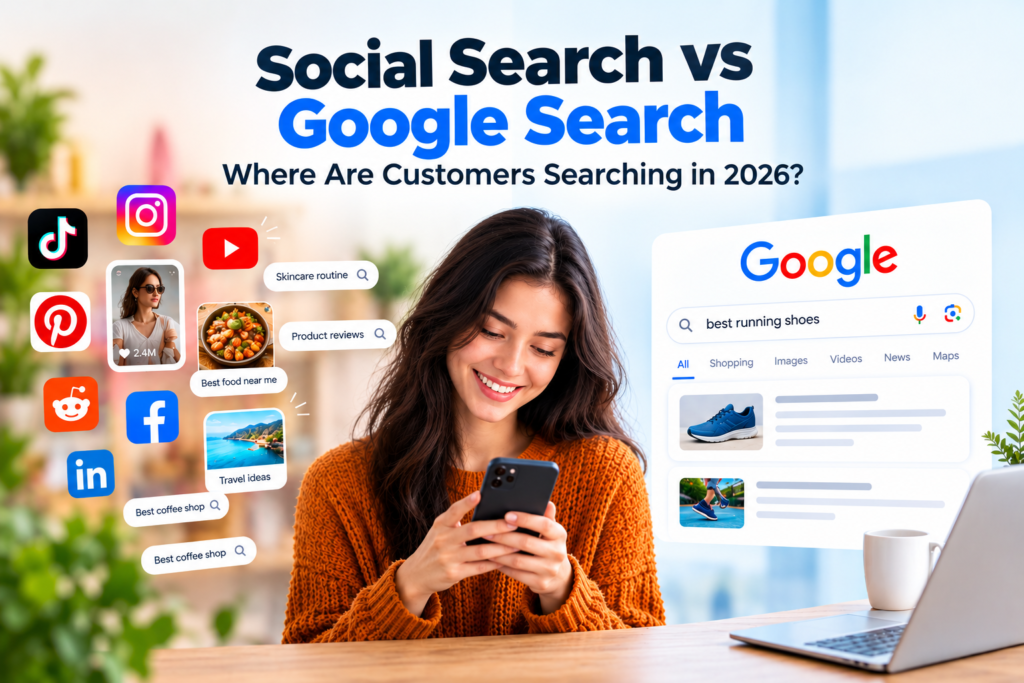
A few years ago, “search” meant one thing: opening Google and typing a question. In 2026, that’s no longer the whole story.
A shopper might scroll TikTok for a product recommendation, jump to Instagram to see what a creator actually thinks of it, open Google to compare prices, check Reddit for an unfiltered opinion, and then use Google Maps to find the nearest store that stocks it, all before lunch. None of these steps happened on a single platform, and none of them felt unusual to the person doing it.
This is the reality behind the debate over Social Search vs Google Search. Customers no longer rely on one destination to find information, products, services, or recommendations. They move fluidly between search engines and social platforms, often within the same buying decision. Search Google for detailed information. Search Instagram for product inspiration. Search TikTok for a quick recommendation. Search YouTube for a tutorial. Search Reddit for a real opinion from someone who isn’t trying to sell them anything.
For business owners, marketers, and SEO professionals, this shift raises a practical question: if customers are searching everywhere, where should a brand actually show up? The honest answer is that there is no single winner. The businesses that succeed in 2026 are the ones building a multi-platform search strategy rather than betting everything on one channel. This article breaks down how social search and Google Search have each changed, where customer search behavior is heading, and how to build visibility across both.
Social search refers to the practice of using social media platforms, rather than a traditional search engine, to look for information, products, services, or recommendations. It’s what happens when someone types “best coffee shop near me” into Instagram’s search bar instead of Google, or scrolls TikTok for “skincare routine for dry skin” the way they might once have Googled it.
Social media platforms weren’t originally built for this. Instagram started as a photo-sharing app, TikTok as a short-video entertainment platform, and Reddit as a network of niche discussion forums. Over the past few years, all of them have evolved into genuine discovery destinations, with search bars, algorithmic recommendations, and content formats that function a lot like search results.
A quick look at how each platform is being used for social media search today:
People turn to these platforms for product recommendations, restaurant and travel ideas, tutorials, honest reviews, trending topics, beauty and fashion inspiration, local businesses, creator opinions, and real customer experiences, much of it delivered as short video or user-generated content rather than a written article.
Social Search in 2026 looks noticeably different from even a couple of years ago. A few shifts stand out:
The data backs up the scale of this shift. According to Sprout Social’s 2026 research, a meaningful share of Gen Z now say they turn to social platforms first when looking for information, ahead of traditional search engines, with figures across various 2026 surveys ranging from roughly 40% to 46% depending on the study and the specific behavior measured. Adobe’s 2026 research similarly found that a quarter of Gen Z consumers rated TikTok as effective for finding information, compared with much smaller shares of older generations.
What this points to isn’t a replacement of search, it’s the emergence of social platforms as genuine discovery engines in their own right, sitting alongside traditional search rather than simply distributing content that started somewhere else.
Google hasn’t stood still either. Google Search in 2026 is built around a much heavier layer of AI, and the search results page itself looks and behaves differently than it did even two years ago:
Industry data shows just how much AI features have reshaped the results page. BrightEdge’s 2026 tracking found AI Overviews appearing on roughly half of tracked queries, up sharply from the year before, and Google confirmed at its 2026 I/O event that AI Mode had surpassed a billion monthly users. Multiple studies from Pew Research, Ahrefs, and Seer Interactive have found that when an AI Overview appears, the click-through rate to the traditional top-ranking result drops significantly, in some studies by more than half, because more users get their answer directly on the results page without needing to click through.
None of this means Google is losing relevance. It means the way people interact with Google is changing. For anything involving detailed research, side-by-side comparisons, local information, high-intent purchase decisions, or a need to verify a source, Google, and specifically its ability to surface trusted, authoritative content, remains difficult to replace. Someone comparing insurance policies, researching a medical question, or checking a business’s official hours is still far more likely to end up on Google than on a social feed.
The honest picture is not “Google vs. social search” as a fight with one winner. It’s two systems evolving in parallel, each getting better at what it’s suited for.
Comparing Google vs Social Media Search side by side makes the different roles each one plays much clearer.
Factor | Google Search | Social Search |
Primary purpose | Answering specific queries with authoritative, indexed information | Discovering ideas, products, and opinions through a feed-based experience |
Search intent | Often high-intent and research-driven | Often inspiration-driven or early-stage discovery |
Product discovery | Strong for comparing named products and prices | Strong for discovering products a user didn’t know they wanted |
Reviews | Aggregated star ratings and written reviews | Unscripted opinions from creators, users, and communities |
Local discovery | Very strong, backed by Google Maps and Business Profiles | Growing, mainly through local creators and community posts |
Tutorials | Strong via long articles, images, and embedded video | Very strong via short-form and long-form video |
User-generated content | Present, but less central | Central to how trust is built |
Purchase research | Detailed comparisons, specs, and pricing | Social proof, demonstrations, and creator endorsements |
Visual discovery | Growing through image and visual search | Native strength, especially on Instagram and Pinterest |
Gen Z usage | Still used heavily for research and comparison | Increasingly used as a first stop for discovery |
Brand discovery | Through search ads, organic ranking, and reviews | Through creators, trends, and shareable content |
Content format | Primarily text and structured web pages | Primarily video, images, and short posts |
Best suited for | Deep research, comparisons, local information, trusted sources | Inspiration, authentic recommendations, fast visual answers |
The takeaway from this comparison isn’t that one column beats the other. It’s that a well-informed customer journey in 2026 usually touches both columns before a decision gets made.
Customer search behavior has become genuinely fragmented. Fewer people complete an entire research journey on a single platform. Instead, they move between platforms depending on what stage of the decision they’re at.
A typical path might look like this:
Discovery → Social Media → Google → Reviews → YouTube → Purchase
Someone spots a product on TikTok, Googles the brand name to check it’s legitimate and compare prices, reads reviews to see if other buyers were happy, watches a longer YouTube video to see the product in more detail, and then completes the purchase, sometimes on the brand’s website, sometimes directly inside the social app.
This pattern shows up clearly across 2026 research on search trends 2026 and search behavior in 2026. Sprout Social’s 2026 statistics found that platforms like YouTube, TikTok, and Instagram now account for a large share of product discovery, while general search engines account for a smaller, though still substantial, portion of it. Separately, roughly two-thirds of U.S. consumers reported having used some form of social search by early 2025, and a majority of users across recent surveys said they now prefer researching products on social platforms rather than relying solely on a search engine.
What this means practically is that a business rarely loses or wins a customer in one single search. It happens across a sequence, and disappearing from any one of those steps, a missing Google Business Profile, no presence on TikTok, no reviews on Reddit, creates a gap the customer will notice, even if they can’t name exactly what felt “off.”
Of all the generations, Gen Z shows the clearest shift toward social platforms as a search destination, though even here, Google hasn’t disappeared from the picture.
Multiple 2026 surveys point in the same direction. Sprout Social’s research found that a meaningful share of Gen Z now search social media before Google when looking for information, and separate Hootsuite-cited data found that a notable share of Gen Z have used TikTok specifically to search, with Instagram and TikTok overtaking Google for certain kinds of product discovery. Adobe’s 2026 survey found Gen Z rated TikTok as an effective way to find information at a far higher rate than older generations did.
By category, this shows up in fairly predictable ways:
The common thread across these categories is that Gen Z tends to trust visual content, creator opinions, and unpolished, authentic experiences over a search engine’s ranked list of links or a brand’s own marketing copy. That doesn’t mean Google is irrelevant to this generation, it’s still used heavily for comparison and verification, but it’s no longer the automatic first stop it once was.
Search behavior isn’t limited to typing a question into a search bar and reading an article. People use online search for a much wider range of everyday needs, and understanding this range helps explain why search has become so fragmented across platforms.
The most familiar type: people search for answers, explanations, how-to guides, and definitions. This is where Google, YouTube tutorials, and increasingly TikTok all compete for attention.
People search to compare products, read reviews, and find recommendations before buying, often spread across a search engine, a social platform, and a retailer’s own site.
People look for nearby restaurants, hospitals, stores, and service providers. This is one of the areas where Google, backed by Google Maps and Business Profiles, still leads clearly.
Sometimes a search is far more specific: someone needs to find a legitimate way to get in touch with a business. A search like “online search phone number” usually reflects someone trying to track down a publicly listed customer-service number, a business’s official contact page, or verified contact details, rather than anything invasive. These searches are a normal part of the customer journey, a person who’s already decided to buy or ask a question just needs the right way to reach a business.
Related to this, some users search for publicly available information about a person, confirming a professional’s credentials, checking a service provider’s public profile, or verifying someone before a transaction. The phrase “search people online for free” typically describes this kind of legitimate, public-information lookup, distinct from anything that infringes on someone’s privacy.
Visual discovery is also a distinct type of search. People use reverse image search to identify a product, find similar items, or trace where a photo originated. A search like “people image search online free” generally falls into this broader category of visual and image-based discovery, part of the same shift toward visual and multimodal search that’s showing up across both Google and social platforms.
Taken together, these examples show that “search” in 2026 covers a lot more ground than a single informational query. It includes local discovery, contact lookups, verification, and visual search, all of which are increasingly split across Google, social platforms, and dedicated tools rather than sitting in one place.
AI campaign optimization allows marketers to analyse live campaign data and adjust budget, targeting, creatives, keywords, or landing pages much faster than manual review would allow, helping catch underperformance early rather than after a campaign has run its course.
AI marketing tools now exist across nearly every marketing function: SEO, content, social media, paid advertising, analytics, automation, lead generation, and even customer support. The challenge for most agencies isn’t finding tools; it’s choosing the right ones.
Rather than adopting every new tool that launches, agencies get better results by selecting AI marketing automation tools based on specific goals, whether that’s cutting reporting time, improving lead scoring accuracy, or speeding up content production, and integrating them properly into existing workflows.
AI marketing automation is one of the clearest time-savers available to agencies today. It’s commonly used to automate:
By removing these repetitive tasks from a team’s plate, automation frees up time for strategic thinking, creative work, and closer client collaboration: the parts of the job that genuinely benefit from human judgment.
Some of the more effective AI powered marketing strategies agencies are using include:
Used consistently, these strategies help campaigns improve over time rather than starting from scratch with every new push, contributing to more sustainable, compounding growth.
AI marketing solutions give agencies a practical way to scale without simply hiring at the same rate as client growth. They help agencies manage more accounts, reduce repetitive manual work, improve campaign efficiency, and deliver reports faster.
Consider a mid-sized agency running SEO, paid ads, and social media for a growing e-commerce client. AI tools might handle initial keyword clustering and content briefs, automate weekly performance reports, flag underperforming ad sets for review, and suggest audience segments for a new product launch. The account team still makes the final calls, but they’re making them with better information, faster, and with more time left over for client strategy conversations.
No. Social search is not simply replacing Google Search. What’s actually happening is that search behavior is becoming more fragmented, with different platforms serving different purposes at different stages of the same decision.
A few real-world scenarios make this easier to see.
Instagram → discover a restaurant through a food video or post Google → check its location, hours, and reviews Google Maps → get directions YouTube or TikTok → watch a video of the actual food and atmosphere before deciding
TikTok → discover a product through a creator or trend Instagram → see how creators are actually using or reviewing it Google → compare prices and alternatives Reddit → read unfiltered user experiences Website → complete the purchase
Instagram → get destination inspiration TikTok → see specific recommendations and itineraries Google → do detailed research on logistics and costs Reddit → read honest traveler experiences Google Maps → confirm locations and reviews on the ground
In every one of these paths, no single platform does the whole job. Google remains essential for verification, comparison, and location-based detail. Social platforms remain essential for discovery, inspiration, and authentic opinion. This is exactly why a multi-platform search strategy matters more than picking a side.
For businesses, the practical implication is straightforward: if customers are discovering brands through social platforms, then those platforms need to be treated as search surfaces, not just broadcast channels.
A few components of a working Social SEO strategy:
None of this replaces traditional SEO. It runs alongside it, aimed at a different set of search surfaces that a growing share of customers are now using first.
A multi-platform search strategy means treating discoverability as something that has to be built across several channels at once, rather than optimizing for Google alone and hoping social visibility follows naturally.
In practice, that means thinking in terms of:
Google + Instagram + TikTok + YouTube + Reddit + Google Maps + AI Search
One useful way to apply this is to take a single topic and adapt it deliberately for each channel, rather than posting the same content everywhere unchanged:
Approached this way, a single piece of research or expertise creates multiple, separate opportunities for a customer to discover the business, on whichever platform they happen to be searching on when the need comes up.
A practical, step-by-step approach for putting this into action:
No, and treating this as an either/or decision is one of the more common mistakes businesses make. Each channel plays a distinct role in the customer journey, and together they cover far more ground than any one of them could alone:
These aren’t competing budgets fighting for the same customer. They’re complementary systems that intercept the same customer at different points, before they know what they want, while they’re comparing options, and right before they’re ready to act.
Looking ahead, the Future of Online Search points toward continued fragmentation rather than consolidation around any single platform. A few trends are likely to keep shaping it:
The direction is clear enough: search is becoming distributed across multiple platforms rather than controlled by any one destination. Businesses that plan around that reality, rather than waiting for it to consolidate back into a single channel, will be better positioned as these trends continue to play out.
What is social search? Social search is the practice of using social media platforms like Instagram, TikTok, YouTube, or Reddit to look for information, products, or recommendations, instead of using a traditional search engine.
Is social search replacing Google Search in 2026? No. Social search is growing alongside Google Search rather than replacing it. Different platforms serve different purposes, social platforms tend to drive discovery and inspiration, while Google remains central for research, comparison, and local information.
What is the difference between Google Search and social search? Google Search is generally used for direct, high-intent queries and detailed research, while social search is used more for discovery, inspiration, and authentic, community-driven opinions, often through video and visual content.
Where does Gen Z search for information? Gen Z uses a mix of platforms, but 2026 research shows a growing share turning to TikTok, Instagram, and YouTube first for discovery, while still using Google for comparison and verification.
What is Social SEO? Social SEO is the practice of optimizing social media profiles and content, including captions, video titles, alt text, and keywords, so that a business appears more easily in searches performed directly within social platforms.
Why is social search important for businesses? Because a growing share of customers now discover products, services, and businesses through social platforms before ever reaching a search engine. Ignoring social search means being invisible during an increasingly common part of the customer journey.
What is a multi-platform search strategy? It’s an approach to visibility that treats Google, social platforms, AI search, and local search as complementary channels, rather than optimizing for only one and assuming the rest will follow.
What is the future of online search? The future points toward search becoming more distributed across AI-powered tools, social platforms, and traditional search engines, rather than being controlled by any single destination.
The real story in 2026 isn’t Google vs. social search, it’s Google + social search + AI search + whatever discovery platform comes next. Customers now move across all of these at different points in the same decision, and expecting them to funnel through one single channel no longer matches how people actually behave.
The practical takeaway for any business is to understand where customers are at each stage of their journey, discovery, research, validation, and purchase, and build genuine visibility at each of those stages, on the platforms where they’re actually looking.
The brands that win in 2026 won’t simply rank where people search. They’ll be discoverable wherever people go looking for answers, recommendations, reviews, and proof.