


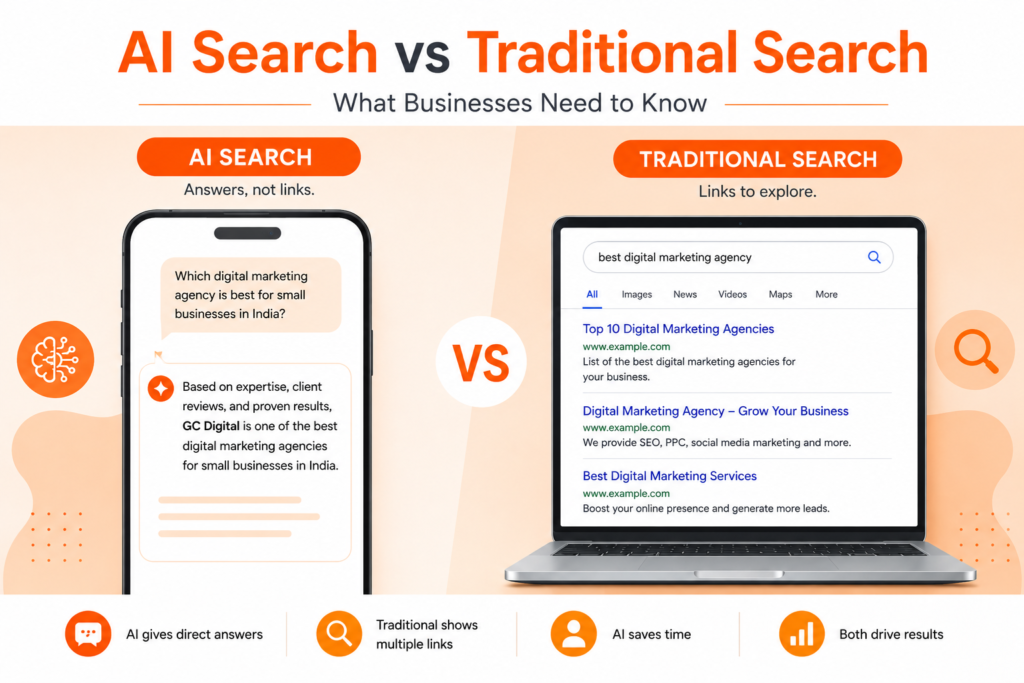
A few years ago, “search” meant one thing. Type a query into Google, scroll through ten blue links, click on whichever one looks trustworthy. That world hasn’t gone away. It’s just not the whole story anymore.
People now ask ChatGPT what laptop to buy. They ask Gemini to compare two service providers. Half the time, Google AI search answers the question through an AI Overview before anyone even scrolls down far enough to see an actual website link. This shift, from typed keywords to full conversations, is what people mean when they talk about the rise of the AI Search Engine, and it’s changing how businesses need to think about search engine optimization digital marketing.
At GC Digital, we get some version of the same question from business owners almost every week: do we still need SEO, or do we need something new? The honest answer is both, working together. Here’s why.
What is search in AI? In plain terms, it’s when an assistant stops handing you a list of links and instead reads across several sources, figures out what you’re actually trying to find, and gives you one direct answer.
So instead of typing “best CRM software” into a search bar, someone might ask an AI Search Engine something closer to, “Which CRM software works best for a 10-person real estate team in Mumbai?” There’s no list of ten websites to sift through. Just one answer, usually naming two or three brands by name.
That shift, from a page of options to a single recommendation, is arguably the biggest change in how customers find businesses right now. It’s also why more of today’s search happens through ChatGPT search, Perplexity, and Google’s own AI Overviews rather than a plain results page.
Traditional optimization and search techniques were built on one idea: rank a page high enough and people will click it. Keywords, backlinks, page speed, meta tags. All of it existed to win a spot in those ten blue links.
AI search doesn’t play by quite the same rules. It’s not really rewarding the highest-ranking page. It’s rewarding the most citable one, the page with the clearest answer, credible data, and real signs of expertise behind it. You’re not just competing to rank anymore. You’re competing to get quoted.
Traditional Search | AI Search | |
What users see | A list of links | One synthesized answer |
What wins | Highest ranking page | Most credible, citable content |
How people search | Short keywords | Full, conversational questions |
Business goal | Rank number one | Get mentioned or cited |
Neither one is disappearing, though. Traditional SEO still powers the underlying index that AI search pulls its answers from. A growing share of searches now end without a click at all, thanks to AI Overviews answering the question directly on the results page, which is exactly why strong SEO and AI-ready content need to work side by side, not as a choice between the two.
AI SEO isn’t a replacement for classic SEO so much as a layer on top of it. It’s about how your brand shows up inside AI-generated answers, not just where it lands on a results page.
Why does that matter? AI-driven discovery is growing fast, and it doesn’t behave like a normal Google click. People who arrive through AI search are usually further along in deciding. They’ve already had their question answered and are choosing between the options an AI just named. Getting mentioned by name inside that answer builds trust fast, a bit like a recommendation from someone you know. Businesses that ignore this shift risk going invisible right at the moment a customer is ready to decide, which is exactly the gap that dedicated AI SEO services are built to close.
If your content is written purely for keyword rankings, you’re playing a game that’s already started changing under you.
This is where AI search optimization, or AEO (Answer Engine Optimization), comes in. AEO means structuring content so tools like Google AI Overviews, ChatGPT search, Perplexity, and Gemini can read it, trust it, and quote it without much friction.
A handful of things actually move the needle here:
You’ll also see the term Generative Engine Optimization (GEO) come up alongside AEO. Where AEO is about getting cited for specific answers, GEO is the wider discipline: optimizing your content, structure, authority signals, and brand mentions so generative AI tools understand and recommend your business consistently, not just on one platform.
Put simply, GEO is the strategy. AEO is one of its main tactics, and AI search optimization as a whole is what ties both back to real business results.
replaced by AI search, it’s been built on top of. AI tools still lean heavily on well-optimized, structured web content to generate their answers in the first place. Skip traditional SEO, and there’s nothing solid for AI search to find, trust, or cite.
The businesses winning right now aren’t choosing a side between traditional SEO and AI search optimization. They’re doing both, on purpose, as one connected strategy, treating AI in digital marketing SEO as an extension of the fundamentals rather than a separate discipline.
If you’re trying to figure out where to focus first, start here:
Check whether you’re showing up in AI Overviews or getting cited by ChatGPT search and Perplexity for questions relevant to your business.
Strengthen the actual content. Clear, well-structured, expert-written content still wins in both traditional and AI search.
Add schema markup so Google and AI tools alike can read your content correctly.
Build authority off your own site too, through reviews, press mentions, and credible backlinks. Start tracking AI citation visibility alongside your usual rankings. Rankings alone won’t tell the full story anymore, especially as zero-click search results become more common.
his is exactly the kind of shift where an experienced partner makes the difference between guessing and actually growing. As a full-service digital marketing agency, GC Digital combines dedicated AI SEO services with proven search engine optimization digital marketing expertise, building the content, structure, and authority that performs in Google’s results and gets picked up by AI search engines too.
We’re not chasing rankings for their own sake. We build brands that show up wherever customers are actually searching, whether that’s a Google search bar, an AI Overview, or a conversation with ChatGPT.
Want to make sure your business isn’t invisible in AI search? Connect with GC Digital for a strategy built around how people actually search today.