


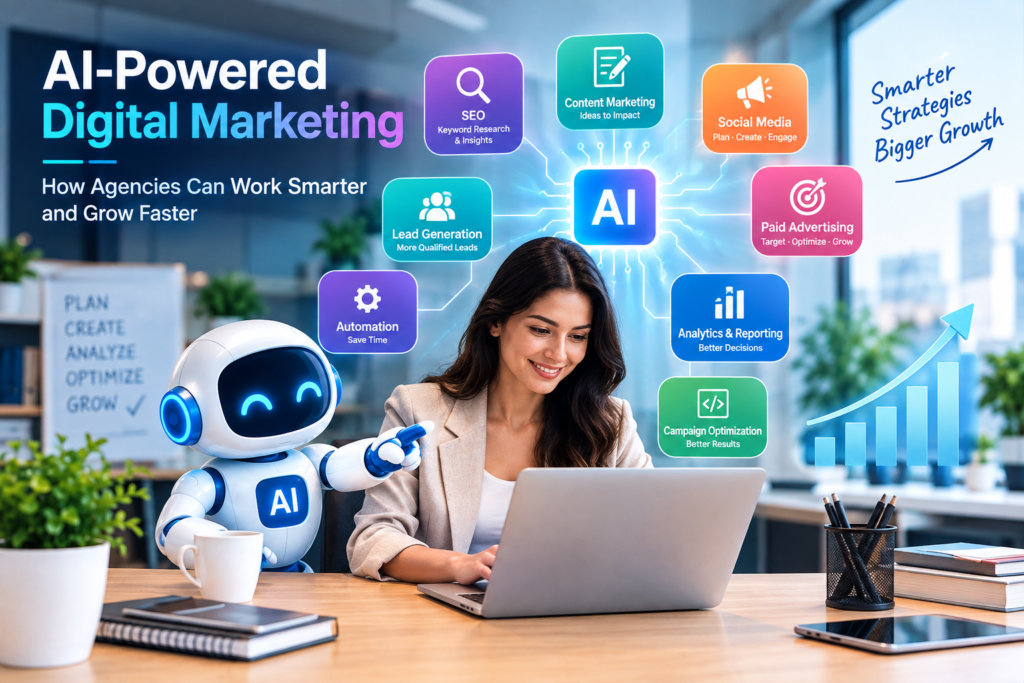
Marketing teams used to spend hours on tasks that AI now handles in minutes: sorting through campaign data, drafting content outlines, or spotting patterns in customer behaviour. That shift is at the heart of AI powered digital marketing, a trend reshaping how agencies plan, execute, and scale campaigns in 2026.
The technology doesn’t replace marketers so much as give them better tools for faster, more informed decisions. As AI in digital marketing becomes mainstream, agencies that adopt it thoughtfully are seeing gains in efficiency, personalization, and client results, while those that ignore it risk falling behind on speed and insight. This article looks at how AI is actually being used inside agencies today, what it changes, and where a human hand still matters.
At its simplest, AI-powered digital marketing means using artificial intelligence in marketing to support research, content, targeting, and optimization, rather than doing everything manually.
This covers a mix of technologies:
The difference between AI based digital marketing and traditional digital marketing isn’t the strategy itself; it’s the speed and depth of the groundwork. A traditional approach might take days to analyse a competitor’s content gaps; an AI-assisted one can surface the same insights in a fraction of the time, leaving more room for a marketer to interpret and act on them.
Client expectations have changed. Businesses want faster turnarounds, more personalized campaigns, and clearer reporting, often without a bigger budget. This is where AI for digital marketing agencies makes a practical difference, particularly in:
Agencies that build these capabilities into their workflow aren’t just working faster; they’re able to take on more clients without proportionally increasing headcount.
AI for SEO has become one of the most practical applications of this technology. It can assist with:
With AI Search, Answer Engine Optimization (AEO), and Generative Engine Optimization (GEO) growing in relevance, agencies are also structuring content so it can be understood and cited by AI-driven search tools, not just traditional search engines. This doesn’t replace core SEO fundamentals; it adds a new layer to consider alongside them.
AI content marketing tools are widely used for blog ideation, outlines, and first drafts, as well as repurposing a single piece of content into multiple formats: a blog into social posts, or a webinar into a short video script.
That said, human editing remains essential. AI-generated drafts still need fact-checking, a consistent brand voice, and original insight that reflects real expertise, something audiences and search engines are both increasingly good at distinguishing from generic, templated writing.
AI social media marketing tools support content planning, caption drafting, and trend spotting. They’re also useful for social listening, tracking what audiences are saying about a brand or industry, and for analysing which post formats and posting times actually perform best for a given account, rather than relying on guesswork.
AI for paid advertising has changed how campaigns are built and managed. On platforms like Google Ads and Meta Ads, AI already assists with:
This means media buyers can spend less time on manual bid adjustments and more time on strategy and creative direction.
AI lead generation tools help businesses identify likely customers, score leads based on engagement and intent, and personalize outreach automatically. They can also flag when a lead shows buying signals, like repeat visits to a pricing page, so sales teams follow up at the right moment instead of missing the window.
AI campaign optimization allows marketers to analyse live campaign data and adjust budget, targeting, creatives, keywords, or landing pages much faster than manual review would allow, helping catch underperformance early rather than after a campaign has run its course.
AI marketing tools now exist across nearly every marketing function: SEO, content, social media, paid advertising, analytics, automation, lead generation, and even customer support. The challenge for most agencies isn’t finding tools; it’s choosing the right ones.
Rather than adopting every new tool that launches, agencies get better results by selecting AI marketing automation tools based on specific goals, whether that’s cutting reporting time, improving lead scoring accuracy, or speeding up content production, and integrating them properly into existing workflows.
AI marketing automation is one of the clearest time-savers available to agencies today. It’s commonly used to automate:
By removing these repetitive tasks from a team’s plate, automation frees up time for strategic thinking, creative work, and closer client collaboration: the parts of the job that genuinely benefit from human judgment.
Some of the more effective AI powered marketing strategies agencies are using include:
Used consistently, these strategies help campaigns improve over time rather than starting from scratch with every new push, contributing to more sustainable, compounding growth.
AI marketing solutions give agencies a practical way to scale without simply hiring at the same rate as client growth. They help agencies manage more accounts, reduce repetitive manual work, improve campaign efficiency, and deliver reports faster.
Consider a mid-sized agency running SEO, paid ads, and social media for a growing e-commerce client. AI tools might handle initial keyword clustering and content briefs, automate weekly performance reports, flag underperforming ad sets for review, and suggest audience segments for a new product launch. The account team still makes the final calls, but they’re making them with better information, faster, and with more time left over for client strategy conversations.
|
Factor |
Traditional Marketing |
AI-Driven Marketing |
|
Data analysis |
Manual, time-intensive |
Faster, pattern-based |
|
Speed |
Slower turnaround |
Near real-time insights |
|
Personalization |
Broad segments |
Granular, behaviour-based |
|
Automation |
Limited |
Extensive |
|
Campaign optimization |
Periodic review |
Continuous adjustment |
|
Scalability |
Constrained by headcount |
Easier to scale |
|
Human involvement |
High across all tasks |
Focused on strategy and judgment |
AI driven marketing works best as a complement to the strategic and creative expertise marketers already bring, rather than a replacement for it.
AI can process data and generate drafts, but it can’t replace strategic thinking, creativity, or a genuine understanding of a brand’s voice and audience. Human marketers remain essential for:
The most effective agencies treat AI as a tool that augments their team’s expertise, not a replacement for it.
AI adoption isn’t without friction. Common challenges include:
Looking ahead, a few developments are likely to shape how agencies work:
These are realistic extensions of trends already underway, not a wholesale replacement of marketing teams, but a continued shift toward smarter, faster ways of working.
AI powered digital marketing is helping agencies work smarter, improving efficiency, sharpening decision-making, personalizing customer experiences, and supporting faster, more sustainable growth. The agencies getting the most out of it use AI to handle the repetitive work, which frees their teams to focus on strategy, creativity, and client relationships.
For businesses evaluating their marketing approach, it’s worth exploring how an AI-enabled digital marketing agency could support these goals, combining the speed and scale of AI with the judgment and expertise that only experienced marketers bring.