


By Bhaskar Tare, Director, Gloocal Communications | Healthcare Communication & Digital Marketing Professional
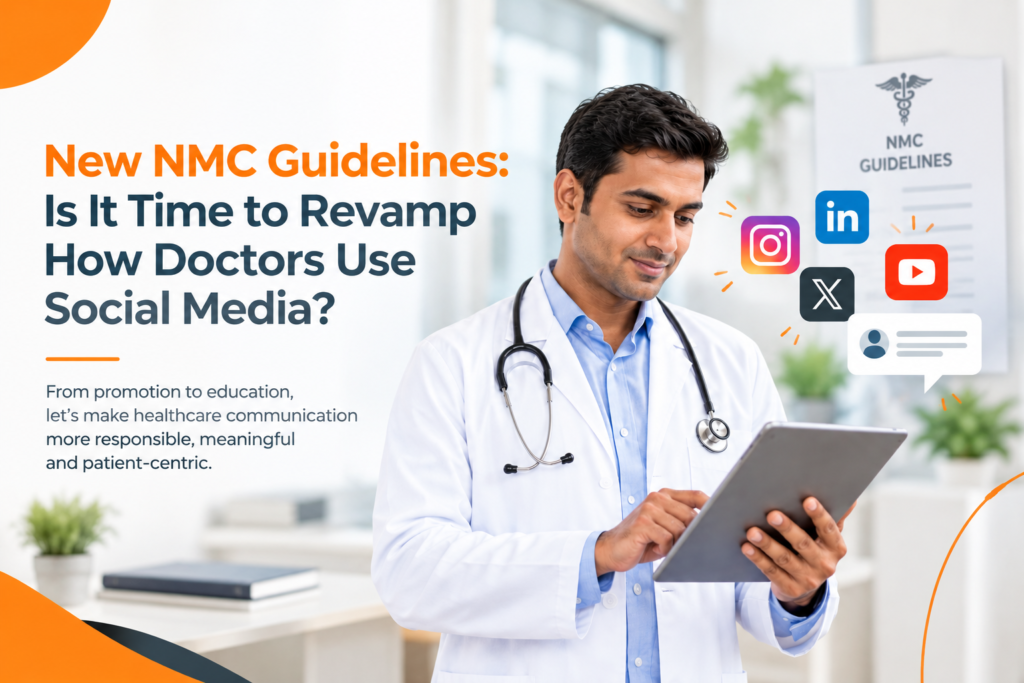
The changing regulatory environment is an opportunity for doctors, hospitals and healthcare institutions to rethink their approach to social media—not by reducing communication, but by making it more meaningful, responsible and patient-centric.
Over the past few days, following discussions around the new National Medical Commission (NMC) guidelines on medical advertising and public communication, a few doctors have reached out to me with concerns about continuing their social media and digital marketing activities.
Some are even considering putting their digital communication on hold.
Having spent over two decades in public relations and communication, with extensive experience working alongside doctors, hospitals and healthcare institutions, I understand their concerns.
However, my response has been simple: Why stop communicating when there is so much valuable medical knowledge that needs to reach the public?
What we need today is not a complete pause in healthcare digital marketing, but a thoughtful revamp of how medical professionals use social media.
The emphasis must shift from promotion to education, from visibility to credibility, and from generating enquiries to creating meaningful public-health awareness.
When I began my journey in public relations in 2005, healthcare communication largely revolved around newspaper interviews, medical breakthroughs, expert opinions, health awareness campaigns and television discussions.
Doctors relied on traditional media to reach audiences beyond their consultation rooms.
Today, the communication landscape has changed dramatically.
A medical expert can explain the early warning signs of cancer through an Instagram reel, discuss heart disease prevention on YouTube or share valuable insights about emerging treatments through LinkedIn.
Social media has made medical knowledge more accessible than ever before.
Through my experience of working with medical experts across specialities, I have realised that doctors possess an enormous amount of knowledge that rarely reaches the general public in a simple, understandable format.
And that is precisely where digital communication can make a difference.
The opportunity is not to make every doctor a social media influencer. It is to make reliable medical knowledge more accessible to society.
Over the years, while interacting with doctors across oncology, cardiology, paediatrics, gastroenterology and several other specialities, I have observed something interesting.
Doctors often discuss complex medical conditions, treatment challenges and patient-related concerns with remarkable clarity during professional interactions.
However, much of this knowledge remains within medical conferences, professional discussions or consultation rooms.
As communication professionals working closely with medical experts, we have an opportunity to bridge this gap.
For instance, when we work on cancer awareness campaigns, the objective should not merely be to highlight a doctor’s expertise.
It should be to help people understand symptoms they might otherwise ignore, misconceptions surrounding cancer treatment or the importance of timely diagnosis.
Similarly, a cardiologist explaining the difference between a heart attack and cardiac arrest can offer information that may help people recognise an emergency.
These are practical examples of how medical expertise can be translated into meaningful public communication.
I have always believed that a doctor’s knowledge becomes even more valuable when it reaches people who genuinely need that information.
The new NMC guidelines should encourage medical professionals to revisit their existing digital marketing and social media strategies.
Over the years, healthcare digital marketing has increasingly adopted practices commonly used in other industries.
There has been considerable emphasis on followers, engagement, promotional videos, patient testimonials and lead generation.
While digital visibility has its importance, healthcare communication cannot be evaluated solely through commercial marketing parameters.
A doctor is not selling an ordinary consumer product.
Patients often seek medical information during moments of anxiety, uncertainty or vulnerability.
This makes accuracy, sensitivity and ethical responsibility extremely important.
Instead of asking how many enquiries a particular campaign can generate, we should also ask how many people it can meaningfully educate.
Healthcare social media communication should be designed to inform patients, not influence them through exaggerated claims or unrealistic promises.
In my view, doctors should approach social media as an extension of their responsibility towards public health education.
An oncologist can explain common cancer myths, warning signs and the importance of appropriate screening.
A cardiologist can discuss lifestyle risks, preventive measures and symptoms requiring urgent medical attention.
A paediatrician can guide parents on childhood health concerns, vaccination awareness and developmental milestones.
A gastroenterologist can explain digestive health problems that people frequently ignore or attempt to manage through self-medication.
The possibilities are extensive.
Short educational videos, expert-led discussions, informative articles, podcasts and disease-awareness campaigns can all play an important role.
However, every piece of content must be medically accurate, appropriately contextualised and consistent with applicable professional guidelines.
The communication should never create unnecessary fear, promise guaranteed outcomes or encourage patients to make medical decisions without proper consultation.
The objective is to help people understand when and why professional medical advice may be necessary.
Our Responsibility as Brand Custodians
Having worked closely with healthcare brands and medical professionals, I believe our responsibility extends beyond creating content and managing social media accounts.
When a doctor or hospital entrusts us with its communication, we become custodians of a reputation built through years of medical education, clinical practice and patient care.
That responsibility must influence every communication decision.
Our role is to understand the medical expert’s perspective, identify subjects relevant to public health and present information in a manner that is accessible without compromising medical accuracy.
Sometimes, it also means advising against a particular headline, visual or promotional approach if it could create an incorrect impression.
This is not about questioning the expertise of medical professionals.
It is about ensuring that their knowledge is communicated appropriately.
A good healthcare communication strategy should protect a doctor’s professional credibility while helping valuable medical information reach a wider audience.
I believe the next phase of healthcare digital marketing will place greater emphasis on credibility, consistency and meaningful engagement.
Doctors and hospitals should continue building their digital presence, but with a clear communication purpose.
Medical experts must remain central to content development, while communication professionals should contribute their understanding of audiences, messaging and digital platforms.
Together, they can create communication that is informative, engaging and responsible.
After more than two decades in this profession, my belief remains unchanged:
Visibility may help people discover a medical professional, but trust is built through knowledge, credibility and consistent communication.
The new NMC guidelines offer an opportunity to strengthen that distinction.