


Digital marketing in 2026 is more powerful than ever before.
AI writes ad copy in seconds.
Automation builds sales funnels automatically.
Algorithms optimize campaigns in real time.
Data predicts what customers will click next.
Growth has become faster. But risk has also increased.
Today, customers verify claims before trusting brands. They compare pricing instantly. They read reviews deeply. They question exaggerated messaging. And when something feels misleading, they expose it publicly.
Reputation spreads faster than advertising.
One unclear offer can create backlash.
One inflated claim can damage credibility.
One insensitive campaign can reduce years of brand equity.
That is why ethical marketing is no longer optional. It is business protection.
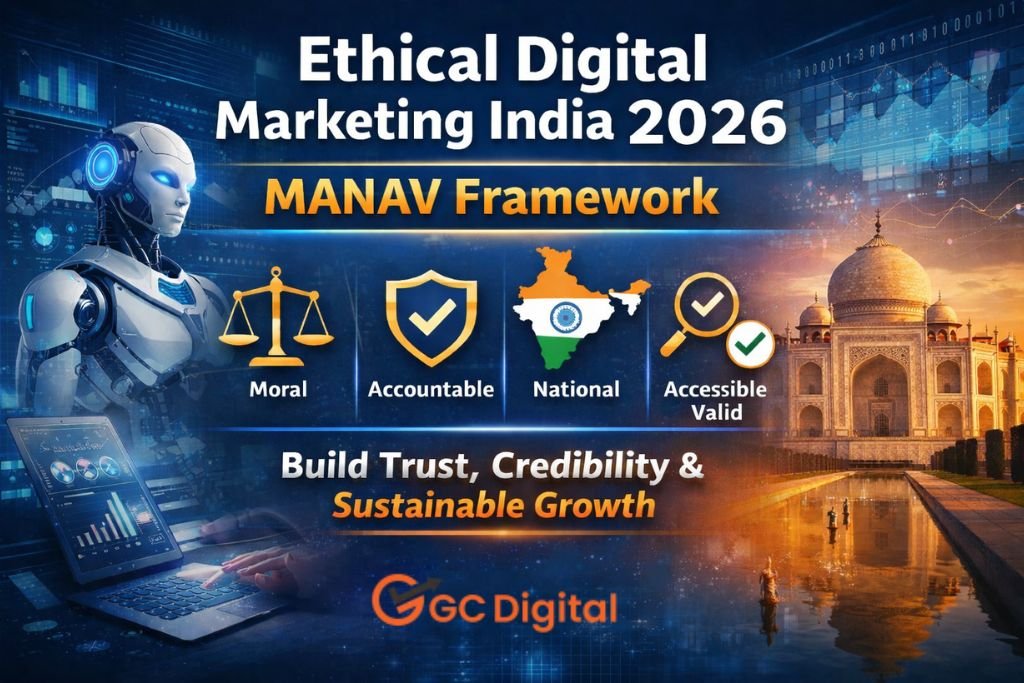
The MANAV framework provides a structured foundation for responsible digital marketing.
MANAV stands for:
It is not about moral theory. It is about operational discipline.
Ethical marketing protects growth. It stabilizes revenue. It builds long-term brand authority.
Moral marketing focuses on honest intent.
It means:
Customers today analyze marketing deeply. They cross-check claims. They compare alternatives. They validate testimonials.
Honest communication builds long-term psychological trust.
Short-term hype creates volatility.
Ethical clarity creates stability.
Accountability ensures responsibility behind every message.
This includes:
When mistakes occur, responsible brands acknowledge and fix them.
Silence creates suspicion.
Ownership builds authority.
Accountability also improves internal team discipline and reduces compliance risks.
India is diverse in culture, language, and sentiment.
Marketing must consider:
A message that feels normal in one region may feel insensitive in another.
National awareness ensures marketing connects instead of alienates.
Context awareness reduces reputational risk
Accessibility means clarity and inclusivity.
Brands should:
If customers struggle to understand your offer, trust decreases.
Accessibility improves:
Validity protects credibility.
Every statistic, claim, and testimonial must be accurate and verifiable.
Avoid:
Fact-based communication builds authority in competitive markets.
Validity reduces legal and reputational exposure.
Ethical marketing is not just morally correct. It produces measurable and strategic business outcomes.
Brands that follow structured ethical systems experience stronger operational performance and long-term resilience.
When customers trust a brand, they return. Repeat purchases increase lifetime revenue without increasing acquisition costs.
Transparent communication reduces dissatisfaction. Customers who clearly understand offers are less likely to churn.
Aggressive campaigns create temporary spikes. Ethical positioning builds stable, predictable growth.
Brands with structured validation processes face fewer public controversies, legal challenges, and reputation recovery expenses.
Investors value sustainability and risk control. Ethical marketing signals operational maturity.
Vendors, collaborators, and distribution partners prefer working with brands that demonstrate transparency and discipline.
Trust reduces friction in business growth.
Ethics reduces long-term operational risk.
Structured systems improve brand valuation stability.
At GC Digital LLP, ethical marketing is not presented as a slogan. It is built into workflow systems.
We integrate responsibility into campaign execution at every stage.
Before any campaign goes live:
We avoid inflated performance positioning or unrealistic projections.
Structured validation reduces reputational and legal risk.
Clients receive:
We do not manipulate reporting to create artificial success perception.
Clarity builds long-term partnerships.
AI tools improve efficiency but require supervision.
Our governance process includes:
Automation is supervised, not autonomous.
Responsible AI usage protects brand credibility.
For India-focused campaigns, we conduct:
Context influences interpretation.
Cultural awareness prevents backlash and strengthens connection.
Customer data is handled with strict internal discipline.
We avoid:
Responsible targeting builds comfort instead of intrusion.
Trust grows when customers feel respected.
Aggressive marketing often focuses on:
It may create short-term spikes in sales.
However, it often results in:
Ethical marketing focuses on:
Aggressive tactics create volatility.
Ethical systems create durability.
Sustainable brands choose durability over hype.
The MANAV framework provides a structured foundation for responsible digital marketing in India.
Moral principles protect trust.
Accountability strengthens credibility.
National awareness ensures relevance.
Accessibility improves clarity.
Validity safeguards reputation.
In 2026, marketing is not judged only by performance dashboards.
It is judged by integrity, transparency, and long-term consistency.
Brands that build ethical systems today will build stable growth tomorrow.
At GC Digital LLP, performance and responsibility are not separate goals.
They are aligned priorities.
Digital visibility may bring attention.
Ethical credibility builds legacy.